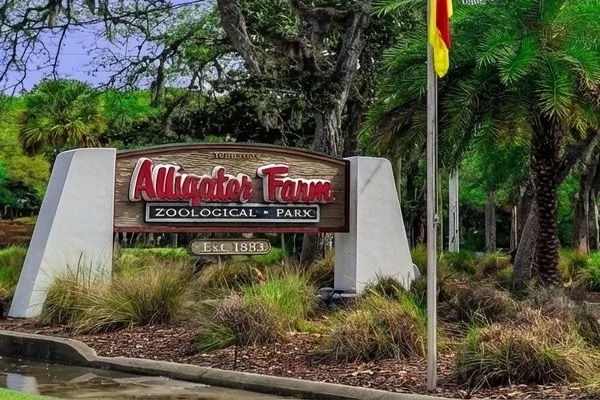
Two men named George Reddington and Felix Fire arrived on Anastasia Island in 1893 with a modest plan. They would put some alligators on display at the end of a railway line, sell a few souvenirs, and make a little money from the tourists Henry Flagler was sending south on his railroad. It was not meant to be a zoological institution. It was meant to be a roadside attraction. One hundred and thirty-three years later, it is the only place on earth with something nobody else in the world has managed to assemble.
Every living species of crocodilian in one location.
There are 24 of them. Alligators, crocodiles, caimans, and gharials — four families, 24 species, scattered across every tropical and subtropical region on earth. The Chinese alligator, critically endangered, with fewer than 150 individuals surviving in the wild. The Indian gharial, whose long narrow snout evolved specifically to catch fish. The Nile crocodile, responsible for more human fatalities each year than any other reptile on the planet. The saltwater crocodile, the largest living reptile, capable of growing past 20 feet and exceeding a ton. They are all in St. Augustine, Florida, at 999 Anastasia Blvd, and they have been collecting them since a railway car dropped tourists off at the beach in 1893.
Reddington and Fire discovered something quickly. The alligators were a bigger draw than the museum. The tourists didn't care about the souvenirs. They wanted to see the reptiles. In 1909, they leaned into it fully and incorporated the South Beach Alligator Farm and Museum of Marine Curiosities.
The farm moved to its current location on Anastasia Island in the early 1920s. A fire devastated the facility in the 1930s and the new owners rebuilt and expanded. The Association of Zoos and Aquariums accredited it in 1989 — the same year they acquired their most famous resident. His name was Gomek.
Gomek was a saltwater crocodile from the jungles of New Guinea. He arrived at the Alligator Farm nearly 18 feet long and weighing close to 2,000 pounds. In New Guinea, he had been well-known to local villagers — not as a beloved neighbor but as something to be feared and avoided. He had a reputation. At the Alligator Farm he was, by most accounts, calm and manageable by the standards of a nearly one-ton saltwater crocodile. He lived at the park for eight years. He died peacefully in 1997 at approximately 70 years old, of heart disease.
He did not disappear. Gomek was preserved and put on display in an exhibit called Gomek Forever, where he remains today — taxidermied, 18 feet of crocodile, surrounded by hand-carved Papua New Guinea art that honors the culture he came from. Three feet away from his preserved body lives his successor: Maximo, a 15-foot, 1,250-pound Australian saltwater crocodile who arrived in 2003 with his mate Sydney. Maximo's habitat allows visitors to observe him both above and below the waterline. Visitors who find this unsettling are advised to consider that Maximo cannot hear them.
In 1993 — exactly one hundred years after Reddington and Fire put their first alligators on a beach — the Alligator Farm opened the Land of Crocodiles exhibit and achieved the distinction it holds to this day: the only facility in the world to exhibit all 24 living crocodilian species simultaneously. The Association of Zoos and Aquariums confirmed it. No other institution has matched it since. The park is also home to the AZA's Crocodilian Biology and Captive Management School, which trains zoologists from around the world in the science of crocodilian care. The roadside attraction has become one of the leading crocodilian research centers on the planet.
The wild bird rookery is perhaps the park's most unexpected feature. Hundreds of native birds — roseate spoonbills, great blue herons, wood storks, snowy egrets — have chosen to nest in the trees directly above the alligator habitats. They nest there because the alligators keep climbing predators away from the rookery. The birds know the alligators won't bother them in the canopy. The alligators benefit from the occasional egg or chick that falls. It is a working partnership between wild birds and captive reptiles that nobody designed and nobody can stop. It happens every spring and it is one of the most striking wildlife spectacles in Florida.
Then there is the white alligator.
Leucistic alligators — sometimes called albino, though the distinction matters to biologists — are American alligators with a genetic condition that eliminates most of their pigmentation. They are born white, with pale blue eyes. They are extraordinarily rare. Fewer than 20 are believed to exist anywhere in the world. In the wild, a leucistic alligator does not last long. Its white skin makes it visible to every predator within range and provides no UV protection from the Florida sun. It cannot camouflage. It cannot ambush. Every survival advantage the American alligator has spent 37 million years developing is unavailable to a white one.
In Cajun folklore, the white alligator is a symbol of purity and good fortune — a sacred animal seen perhaps once in a generation. The St. Augustine Alligator Farm brought theirs from the bayous of Louisiana. Visitors have described them as looking carved from white chocolate.
The habitat is designed specifically around their needs — shaded areas, controlled lighting, protection from the sun that would otherwise destroy skin that has no melanin to defend it. The park's leucistic alligators are among the most photographed animals in St. Augustine. They are also, in a sense, the most honest argument the Alligator Farm makes for its own existence: animals that could not survive a single season in the wild, living full lives in a facility built around understanding what they are.
The park covers 10 acres on Anastasia Island — the same island where the Spanish quarried the coquina stone that built the Castillo de San Marcos, the fort whose walls absorbed 300 years of cannon fire without cracking. The limestone that stopped cannonballs is the same island that has been protecting the Alligator Farm's collection since the 1920s. St. Augustine has a habit of putting its most remarkable things in the same small geography and letting visitors find them on their own.
The zipline — Crocodile Crossing, added in 2011 — runs directly over the alligator habitats. It is exactly what it sounds like. The park is also home to sloths, lemurs, Galapagos tortoises, pygmy marmosets, venomous snakes, and hundreds of bird species beyond the rookery. Live keeper talks and feeding demonstrations run throughout the day. They are worth timing your visit around.
Two men put some alligators at the end of a railway line in 1893 to sell souvenirs. They quickly discovered that nobody cared about the souvenirs.
One hundred and thirty-three years later, the attraction they built to move merchandise is the only place on earth where every living species of crocodilian can be seen in one location. It trains zoologists. It conducts research that shapes how the world understands crocodilian biology. It houses a 15-foot Australian saltwater crocodile and the preserved remains of his 18-foot predecessor from New Guinea. It has a wild bird rookery that operates entirely on the animals' own terms, in partnership with reptiles that nobody told them to trust.
And in a climate-controlled habitat with carefully managed lighting, there is a white alligator from the Louisiana bayou that shouldn't survive a week in the wild — living a full life in a place built precisely for animals like it.
George Reddington and Felix Fire wanted to sell souvenirs. They accidentally built a world record.
You can find it at St. Augustine Alligator Farm Zoological Park, 999 Anastasia Blvd, St. Augustine. Open daily 9 AM–5 PM. Adults $36.99. The white alligator is near the entrance. You'll know it when you see it.
Good day.
The Alligator Farm is 10 minutes from the Castillo de San Marcos on Anastasia Island. Both are worth your time. The coquina that built the fort came from the same island the alligators live on. St. Augustine is like that.