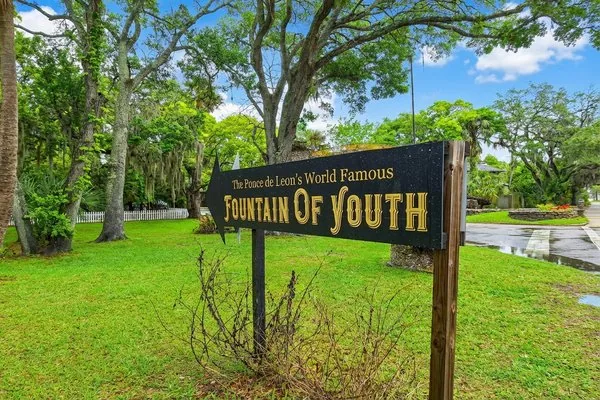
Juan Ponce de León arrived in Florida in April of 1513. He named it La Florida — for the lush landscape and the Easter season, Pascua Florida in Spanish. He claimed it for the Spanish crown. He was 39 years old, the first Governor of Puerto Rico, a veteran of two Atlantic crossings and a man with a great deal of administrative ambition. In all the documents he left behind from his Florida expedition, he mentioned gold, territory, and the Timucua people he encountered. He did not mention the Fountain of Youth. Not once. Not in a single letter, log, or official report.
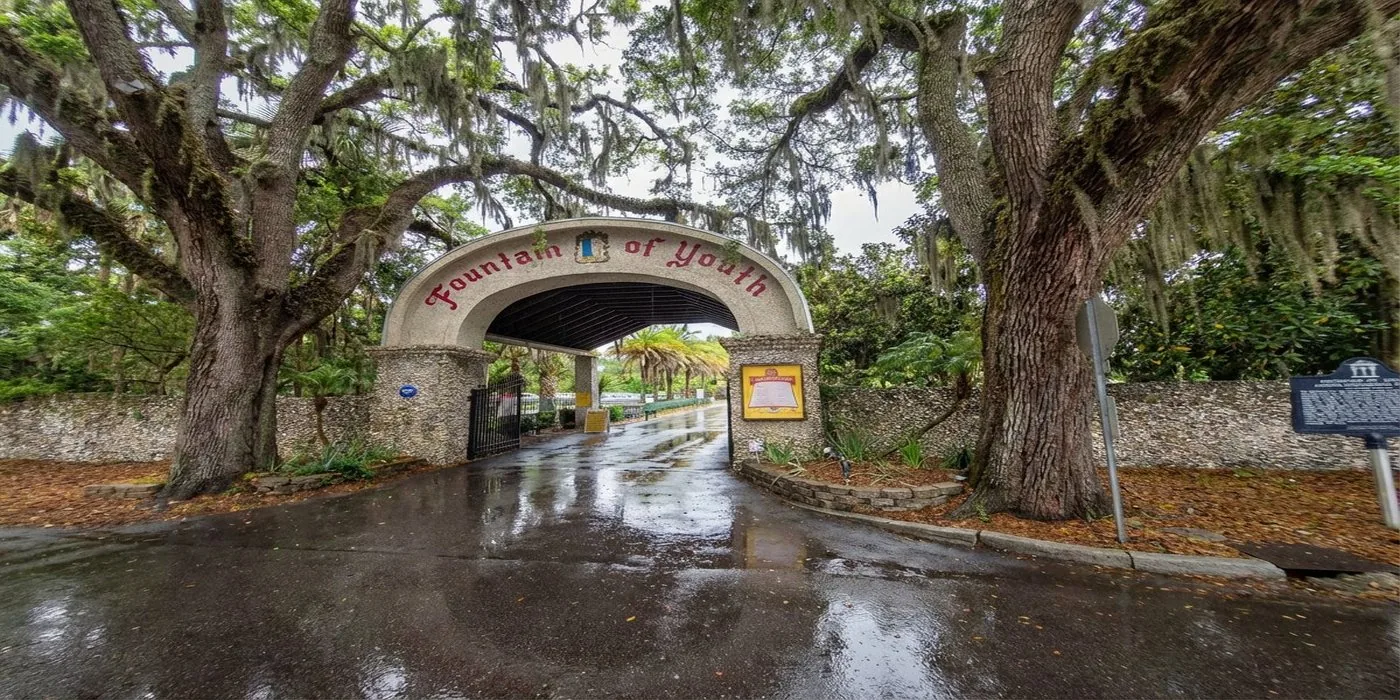
The connection between Ponce de León and the Fountain of Youth was made by a Spanish historian named Gonzalo Fernández de Oviedo y Valdés in 1535 — twenty-two years after the expedition and thirteen years after Ponce de León was dead. Oviedo wrote that de León had been searching for waters that could restore youth. There is no evidence he based this on anything de León actually said. Some historians have suggested Oviedo was writing to generate favor at the Spanish court, where tales of exotic New World discoveries played well. Whatever the motivation, the story stuck.
Ponce de León died in 1521, struck by a Calusa arrow during a second Florida expedition. He was 47. He never mentioned a fountain. He never found one. The legend that bears his name was invented by someone else, after his death, for reasons that had nothing to do with him.
The legend grew over the following centuries, fed by the universal human appetite for the idea that aging could be reversed. Ancient Greek mythology had similar waters. Babylonian mythology had them. Caribbean Taino legends spoke of a restorative spring on a mythical island called Bimini, north of Cuba — and it was likely those Taino stories, filtered through layers of translation and retelling, that gave Oviedo his material in the first place. The idea is older than Florida. It is older than Spain. It may be as old as the human awareness that time moves in only one direction.
What is not old is the specific claim that the Fountain of Youth is located in St. Augustine.
That connection was made in the 1870s — more than 350 years after Ponce de León landed — when a real estate promoter named Henry H. Williams purchased a piece of land just outside the city and dubbed a small stream on the property "Ponce de León Spring." He called it the Fountain of Youth. He sold it as such to visitors. He had no archaeological evidence for the claim. He had a spring and a good story and a city full of tourists arriving on Henry Flagler's new railroad, and that was enough.
Williams sold the property in the early 1900s to a woman named Dr. Luella Day McConnell. She had made her fortune in the Klondike gold rush of 1898 — arriving in the Yukon as a physician, leaving with enough gold to buy the St. Augustine property with cash and diamonds. In St. Augustine she became known as Diamond Lil. She aggressively marketed the attraction, charged admission, sold postcards and water from the well, and — in her most creative contribution to Florida tourism — claimed to have discovered a large cross made of coquina stone on the grounds, asserting it had been placed there personally by Ponce de León himself.
She fabricated stories. She was, by most historical accounts, entertaining about it. She continued fabricating stories to amuse and appall the residents of St. Augustine until she died in a car accident in 1927. Walter B. Fraser, who had managed the attraction under McConnell, purchased the property and turned it into one of Florida's most successful tourist destinations. The first serious archaeological work began under Fraser's ownership.

And here is where the story changes.
Workers digging on the property found human bones. The University of Florida was called in, then the Smithsonian Institution. What they excavated were 90 Native American remains — the earliest known Christian burial of indigenous peoples in what is now the United States. The Timucua people had lived on this land for nearly 3,000 years before any European arrived. The site was the village of Seloy, a Timucua settlement that Pedro Menéndez de Avilés — the Spanish admiral who founded St. Augustine in 1565 — used as the base for America's first European colony. That colony was established 42 years before Jamestown. Fifty-five years before Plymouth Rock.
Diamond Lil invented a legend on top of a real archaeological site of extraordinary importance. The Fountain of Youth doesn't restore youth. It never did. But the land beneath it may be the most historically significant 15 acres in the United States.
Annual archaeological digs continue at the park today. The Fountain of Youth Archaeological Park is now properly accredited and the research is genuine — a 16th-century olive jar, a conch scoop, and a candle holder from the original Spanish settlement have been recovered from the site. The 35-foot watchtower on the grounds marks the spot where a light burning in 1586 led Sir Francis Drake — the English privateer — to spot the settlement and raid it. The Navigators' Planetarium inside the park teaches early European celestial navigation. The peacocks are real and they are everywhere.
The water from the spring, which visitors still drink today, tastes of sulfur. Most people describe it as rotten eggs. This has not historically reduced enthusiasm for drinking it. The signed guest books in the Spring House stretch back to 1868, before Diamond Lil, before Walter Fraser, before the Smithsonian came to dig. People have been drinking sulfur water in St. Augustine and hoping for the best for over 150 years.
The park sits one mile north of the Castillo de San Marcos on San Marco Avenue — the same road that passes the Old Jail that Henry Flagler paid to have hidden from his hotel guests. Two blocks north of the park is the Old Jail. Less than a mile south is the Castillo. The most historically layered mile in Florida, and most visitors drive straight through it to get to the beach.
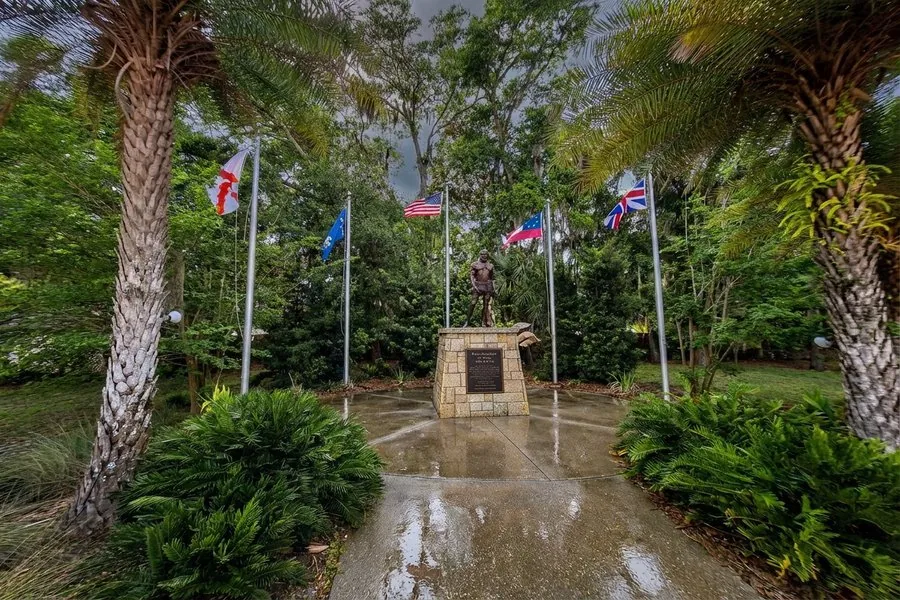
Ponce de León arrived in Florida in 1513. He never mentioned a Fountain of Youth. The story was invented by a Spanish historian 22 years after the expedition, 13 years after de León was dead.
The specific spring in St. Augustine was named by a real estate promoter in the 1870s. The attraction was built and sold by a Yukon gold rush doctor who called herself Diamond Lil and admitted to fabricating stories until she died in a car accident in 1927.
But underneath the invented legend, archaeologists found something real: the oldest Christian burial site of indigenous peoples in the United States. A Timucua village occupied for 3,000 years. The actual site of America's first European colony — 42 years before Jamestown, 55 years before Plymouth Rock.
The Fountain of Youth never worked. The land it sits on is one of the most historically significant sites in the country. Diamond Lil built a tourist attraction on top of it, and the tourists kept coming, and eventually the archaeologists arrived, and now both things are true at the same time.
You can visit it at Fountain of Youth Archaeological Park, 11 Magnolia Ave, St. Augustine. Open daily 9 AM–6 PM. Adults $22.95. The water tastes like sulfur. Drink it anyway.
Good day.
The Fountain of Youth Archaeological Park is one mile north of the Castillo de San Marcos on San Marco Avenue. The peacocks are not confined. You have been warned.